Real Factors Determining the Value of the 1961-D Penny
In 1961, the Denver Mint produced a record-breaking mintage of one-cent coins for that time, totaling 1,770,314,000 specimens.
The "D" mark below the date indicates the coin's origin from this specific production site.
The high mintage volume accounts for the availability of most specimens at face value, yet a narrow segment of high-preservation coins and specific die varieties demonstrates a significant market premium.
A 1961 D penny value is formed based on objective physical characteristics confirmed by public auction results.
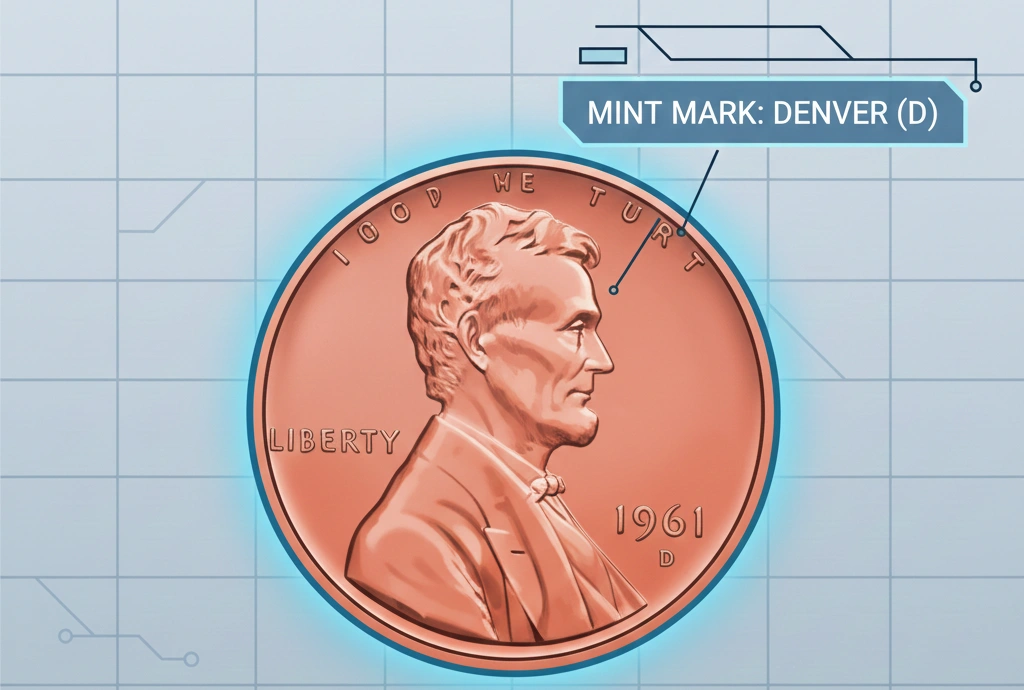
Coin production followed U.S. government standards established for copper-zinc alloys of that period.
The primary product parameters include:
Alloy composition: 95% copper and 5% mixture of tin and zinc.
Standard weight: 3.11 grams (allowable tolerance of +/- 0.13 g).
Diameter: 19.05 mm.
Thickness: 1.55 mm.
Any deviations from these norms recorded during instrumental measurement may indicate rare manufacturing planchet errors.
Preservation Classification and Price Hierarchy
For the 1961-D issue, the critical factor is the surface color classification, divided into Brown (BN), Red-Brown (RB), and Red (RD).
Coins in the RD category, having retained more than 95% of their original mint luster, possess the highest liquidity.
Grade (RD condition) | Average Price (USD) | Auction Record (USD) | Annual Dynamics (%) |
MS64 RD | $2 - $5 | $92 | -1% |
MS65 RD | $8 - $15 | $184 | +0.5% |
MS66 RD | $35 - $75 | $748 | -3% |
MS67 RD | $450 - $900 | $4,406 | +8.5% |
The absolute record for a 1961-D in MS67 RD condition was established in 2014, totaling 4,406 US dollars.
Current market data for 2024–2025 shows decreasing prices for the MS66 grade due to the increasing population of certified specimens, while MS67 RD maintains its deficit status.
Re-punched Mint Mark (RPM) Varieties
A technical feature of the 1961-D issue is the existence of numerous varieties featuring a re-punched mint mark.
These deviations arose from manual hammering of the "D" letter into working dies leading to contour displacement.
Primary Cataloged RPM Variants
1961-D/D (North): The secondary impression of the letter "D" is shifted strictly north relative to the main mark.
1961-D/D (South): Displacement of the lower letter contour in a southern direction.
1961-D/D (Horizontal): A rare case of mark contour rotation.
The market value of confirmed RPMs in MS65 RD condition varies from 25 to 65 dollars.
Statistical analysis shows that the price for certified RPMs grows by an average of 7% per year provided clear visibility of contour separation exists.
Impact of Manufacturing Errors on Value
Besides systemic varieties, the market features random minting defects possessing high value upon certification.
Off-Center Strike: Occurs when a planchet is partially outside the die strike zone. A 50% displacement retaining the 1961 date is valued at $150 - $280.
Die Cap: Happens when a struck coin sticks to the upper die. Such specimens in good condition reach prices of $400 - $600.
Struck Through: The entry of oil or metal dust leaves indentations on the surface. Prices vary from $20 to $120 depending on the defect area.
Degradation Factors and Surface Evaluation
Evaluating the 1961-D penny value according to the Sheldon scale relies on the absence of microscopic damage occurring during storage and circulation.
Carbon Spots
Copper reacting with the environment forms black oxidation dots.
The presence of a single spot exceeding 0.2 mm in diameter automatically lowers the coin grade by 1–2 points, reducing its value by 40–70%.
Die Cracks
Equipment wear led to the appearance of thin relief lines on the coin.
For the 1961-D issue, such cracks on the reverse (BIE-variety in the word LIBERTY or wheat ears) add only $5 - $15 to the price.
Luster Preservation
To obtain an MS67 RD grade, a coin must possess full circular luster without signs of patina.

Population and Grade Survival Statistics
PCGS and NGC population reports and a coin checker app, allow for the accurate determination of specific condition rarity.
Distribution of certified 1961-D (Red) specimens:
MS65 RD: ~12,500 units
MS66 RD: ~4,800 units
MS67 RD: ~165 units
MS67+ RD: ~12 units
MS68 RD: 0 units
The absence of MS68 grade coins in registries confirms the technological difficulty of producing perfect specimens in Denver in 1961.
Professional Asset Evaluation Methodology
Verifying the 1961-D coin's authenticity and value requires following a technical algorithm.
Instrumental Weighing: A mass of 3.11 g excludes counterfeits made from later zinc planchets (2.5 g).
Optical Control under a Coin Value App: Detecting cleaning traces often masked as original luster.
Mint Mark Analysis: Excluding the possibility of mechanical soldering of the "D" letter to a Philadelphia-minted coin.
Professional grading is mandatory for coins claiming MS67 status, as the price difference between MS66 and MS67 exceeds 1000%.
Investment Prospects of the Issue
Long-term trend analysis for the 2010–2025 period indicates the stability of the MS65–MS66 RD segment.
The average annual income from owning confirmed RPMs (FS-501 and others) is 6.2%, exceeding inflation rates.
High volatility is observed in the MS67 RD segment depending on the activity of major auction houses and the appearance of new specimens on the market.
The value decrease for ordinary coins from circulation is approximately 2% per year due to the constant influx of material from old collections lacking high preservation.
Conclusion
The 1961-D penny value is determined exclusively by the combination of a high grade and the presence of rare re-punched die varieties.
The massive mintage makes the vast majority of coins nominal, yet specimens in MS67 RD condition remain highly liquid assets.
Technical RPM diagnostics and physical surface condition control are the only objective methods for identifying value within this issue.
Auction statistics confirm that the financial potential of the 1961-D is concentrated in preserving the original red color and the absence of corrosion processes typical of copper alloys.
-

Stay Safe on the Slopes: A Guide to Skiing and Snowboarding Etiquette
Discover essential tips for staying safe and practicing proper etiquette while skiing and snowboarding. Learn how to navigate the slopes responsibly and create a positive winter sports community at Gl...
-

Mountains of Danger: Winter Survival Tips for the Brave and Bold
Ready to tackle the winter mountains? Discover essential survival tips for avalanche safety, hypothermia prevention, and more. Prepare for your snowy adventure with expert advice on gear, number track...
-

How Do I Choose the Right Ski Boots for My Skill Level?
...
-

U.S. Dimes: History, Key Dates & Collecting Strategies
Discover the most valuable U.S. dimes, from 1796 Draped Bust to modern errors. Learn grading secrets and investment strategies for all budgets....